Photo Tracer Methods: When Artists Work From Reference Images
See Da Vinci Eye in action in the video below.
If you’ve ever wondered how artists capture such realistic proportions and perspectives from photographs, you’re looking at centuries of photo tracer techniques evolving from basic optical tools to modern apps. Working from reference images isn’t just common, it’s been a fundamental part of how artists create accurate, compelling work for generations. Whether you’re sketching a portrait or painting a landscape, understanding how to use reference photos effectively can transform your art practice.
The journey from pinhole boxes to smartphone screens reveals something important. Artists have always looked for better ways to study their subjects and improve their accuracy.
The Camera Obscura: The Original Photo Tracer
The camera obscura is essentially a dark box with a small hole that projects an upside-down image of whatever’s outside onto a surface inside. Artists discovered this optical phenomenon hundreds of years ago, and it became one of the earliest photo tracer methods for capturing accurate perspective and proportions.

To build a basic camera obscura, you need a large cardboard box that’s completely sealed against light. Place white paper on the back wall to act as your projection screen. Then poke a tiny pinhole in the opposite side, that’s where light enters and projects the image.
When you put your head under a blanket at the opening, you’ll see an inverted image of the scene in front of the box projected onto that paper. It’s genuinely magical the first time you see it work. The image appears dim but recognizable, showing you exactly what the lens of a camera would capture.
The challenge is getting a clear enough image to actually trace. The basic single-box setup produces a fuzzy projection that’s hard to work with. That’s why artists refined this tool over centuries, adding adjustable components to control focus and clarity.
Making the Camera Obscura Actually Usable for Drawing
A fixed camera obscura gives you a proof of concept, but if you want to actually trace from it, you need to make some modifications. The key is creating an adjustable focus system by using two boxes, one sliding inside the other.

Cut the back off your larger box and slide a smaller box inside it. Move your projection screen to the back of the smaller box. Now you can slide the inner box back and forth to adjust the distance between the pinhole and the screen until the image comes into sharp focus.
Here’s a practical tip that makes a huge difference. Cut a large viewing hole in the back of the smaller box and create a frame around it where you can tape your drawing paper. This lets you trace from the outside rather than sticking your head inside, which is way more comfortable for extended drawing sessions.
You’ll want a stiff, clear sheet like plexiglass behind your paper. Without a hard surface to press against, your pencil just pushes the paper around and your lines become wobbly and inconsistent. Having that firm backing makes the difference between a frustrating experience and a functional drawing tool.
The blanket wrapped around the back needs to block all light except what’s coming through the pinhole. Even small light leaks wash out your projected image. You’re essentially creating a tiny darkroom where only the controlled light from your subject reaches the screen.
How Historical Artists Actually Used Photo Tracer Tools
Artists didn’t use cardboard boxes like DIY versions do today. Historical camera obscuras were sophisticated instruments, some built as entire rooms where artists could walk inside and work on large canvases.

The more portable versions were crafted wooden boxes fitted with quality lenses and mirrors. These additions dramatically improved both the brightness and clarity of the projected image. Some designs even corrected the upside-down image so artists could trace right-side up.
Landscape painters found camera obscuras especially valuable because perspective and spatial relationships are so critical in outdoor scenes. Getting the relative sizes of distant mountains, middle-ground trees, and foreground elements correct makes the difference between a convincing landscape and one that feels off.
Leonardo da Vinci studied and documented the camera obscura in detail. He understood the optical principles behind it and recognized its value as an artist’s tool. That connection between Renaissance masters and reference tools shows how long artists have embraced technology to improve their work.
These weren’t shortcuts or ways to avoid learning. They were precision instruments that helped artists study light, shadow, and perspective more accurately. The artistic decisions about composition, color, brushwork, and style remained entirely in the artist’s hands.
Modern Photo Tracer Options That Actually Work
Today’s artists have more practical options than building boxes and adjusting pinholes. The core concept remains the same, overlay a reference image onto your drawing surface, but the execution has gotten much more convenient.

Physical methods still exist. Light boxes let you place a reference photo under translucent paper and trace the outlines. Projectors can throw an image onto a wall or canvas for mural work. Grid methods involve drawing a grid over your photo and a corresponding grid on your paper, then copying each square.
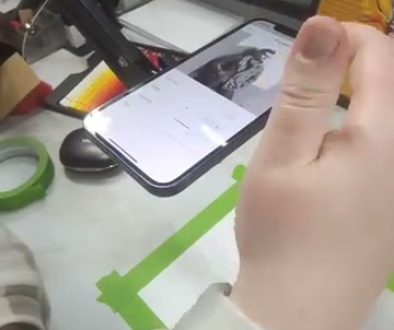
Digital photo tracer apps like Da Vinci Eye use your phone’s camera to create an augmented reality overlay. You see your reference image superimposed on your actual paper through your screen. It’s the camera obscura principle updated for smartphones, giving you a see-through view of both your reference and your drawing surface at once.
What makes modern apps more practical than historical methods is the control they offer. You can adjust the size and position of your reference instantly. Zoom into specific areas to study details. Lock the position so nothing shifts while you’re working. All without building adjustable boxes or struggling with dim projections.
The learning benefit is similar to what Renaissance artists experienced. You’re training your eye to see proportions, angles, and spatial relationships accurately. Your hand learns the muscle memory of recreating those shapes. Over time, you internalize these skills and need the reference less.
Using Photo References Without Losing Your Artistic Voice
Working from photos doesn’t mean you’re just making copies. The reference image is your foundation, but every artistic choice you make on top of that foundation is yours. Your line quality, shading technique, color choices, and stylistic interpretation create something unique.
Think of photo tracer methods as tools for understanding structure. They help you get proportions right so you can focus your creative energy on expression rather than measurement. You’re not replacing your artistic vision, you’re supporting it with accurate observational skills.
Some artists use references to block in basic shapes and proportions, then set the reference aside and work from observation and memory. Others keep the reference visible throughout but interpret it loosely, using it as a guide rather than a rulebook. There’s no single correct approach.
As your skills develop, something interesting happens. You start noticing proportional relationships automatically. Your eye gets trained to estimate angles and measure relative sizes. The reference becomes less of a crutch and more of a confirmation tool.
Different subjects benefit from references in different ways. Portraits demand accurate facial proportions, small errors look obviously wrong. Landscapes allow more interpretive freedom once the basic perspective is established. Still life compositions might need reference for complex objects but imaginative additions for others.
Common Mistakes When Working From Photo References
One of the biggest mistakes is copying every single detail from your photo without making artistic decisions. Photos capture everything equally, but good art emphasizes some elements and simplifies others. You need to decide what matters in your composition.
Lighting in photos can be misleading. Cameras don’t capture light the same way your eye sees it, and you might need to adjust values and contrasts to make your drawing feel natural. Don’t just copy the exact tones from the reference, interpret them.
Working too small is another common issue. If your reference is scaled down too much, you lose the ability to see and capture important details. Make sure your overlay or projection is large enough that you can clearly see the forms you’re trying to draw.
Forgetting to step back and look at your work without the reference is a mistake many beginners make. Regularly remove the overlay or look away from your photo to see how your drawing stands on its own. Sometimes proportions that looked right with the reference visible need adjustment when viewed independently.
Don’t trace every line mechanically without understanding what you’re drawing. Think about the three-dimensional form you’re representing. A traced outline without comprehension won’t teach you anything. Understand the structure as you work, that’s where the learning happens.
Using low-quality or poorly lit reference photos makes everything harder. Blurry images, harsh shadows, or odd perspectives in your source material will translate directly into problems in your finished art. Start with the best reference you can find or create.
Start drawing with Da Vinci Eye