Trace Drawing: The Art Technique That Builds Drawing Confidence
See Da Vinci Eye in action in the video below.
If you’ve ever hesitated to start a drawing because you weren’t sure you could get the proportions right, you’re not alone. That blank page can feel like a huge obstacle, especially when you’re working on something detailed like a portrait or complex still life. Trace drawing, the practice of using reference images to guide your hand, has been helping artists build skills and confidence for centuries, and it’s just as valuable today.
Despite what you might have heard, tracing isn’t some modern shortcut. It’s a legitimate technique that professional artists have relied on throughout history. From Renaissance masters using camera obscuras to contemporary illustrators working with digital overlays, the goal has always been the same: understand structure, nail proportions, and develop your eye for detail.
The History of Trace Drawing in Fine Art
Artists have been using optical tools to transfer images for hundreds of years. The camera obscura, literally a “dark room” with a tiny hole that projects an image onto a surface, was used by painters as early as the 15th century. They’d trace the projected image to capture accurate proportions before adding their own artistic interpretation.

Later tools included the camera lucida, a prism device that let artists see both their subject and their drawing surface at the same time. These weren’t considered tricks or workarounds. They were standard equipment in an artist’s toolkit, right alongside brushes and pigments.
What started as elaborate setups involving dark rooms and mirrors has evolved into something much more accessible. Today’s trace drawing tools fit in your pocket, but the principle remains exactly the same: get the structure right so you can focus on developing your technique and style.
What Trace Drawing Actually Teaches You
Here’s what people often misunderstand about tracing. It’s not about mindlessly copying an image. It’s about training your eye to see relationships between shapes, understand spatial proportions, and recognize how light creates form.

When you trace, you’re actively studying your reference. You notice how far apart the eyes sit on a face, how the shadow under a nose creates depth, where the lightest highlights fall. Your hand is learning muscle memory for curves and angles while your brain is cataloging visual information.
Over time, something interesting happens. You start to internalize these proportions. You begin recognizing patterns in how features relate to each other. Eventually, you’ll find yourself drawing more accurately even without tracing, because your eye has been trained to see correctly.
This is exactly how traditional art training worked for centuries. Apprentices would copy master works to understand technique before developing their own approach. Tracing is just a more efficient version of that same learning process.
How Modern Trace Drawing Works with Your Phone
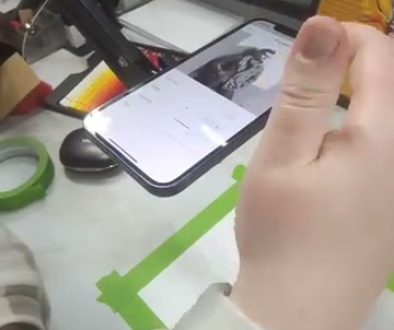
The smartphone in your pocket can do what used to require an entire dark room setup. Apps like Da Vinci Eye use your phone’s camera to overlay a reference image directly onto your drawing surface, letting you see both at the same time on your screen.

The setup is straightforward. You position your phone above your paper using a stand, or even a tall glass with some painter’s tape. The app displays your reference image as a transparent overlay on top of the live camera feed showing your paper.
You can adjust the transparency to see more of your reference or more of your actual drawing. Move the image around by dragging one finger, resize and rotate with two fingers, then tap the lock icon so you can zoom in for details or zoom out to check overall proportions.
This gives you the same benefits artists got from historical optical tools, but with way more flexibility. You can work at any scale, adjust your composition on the fly, and even use features like grayscale filters to focus on values instead of color.
Using Trace Drawing to Build Real Skills
The most effective way to use tracing as a learning tool is to focus on specific skills with each drawing. Don’t just trace the entire image automatically. Pay attention to what you’re doing.

Start with getting the basic proportions down. Notice how wide the head is compared to its height. See where the halfway point falls between the chin and the top of the head. For most faces, it’s roughly at the eyes, not where most beginners think. These relationships are what make a drawing look right.
Once you’ve got the structure, you can start focusing on technique. How do you shade a rounded surface to make it look three dimensional? How light should your initial lines be? What kind of mark making creates realistic texture for hair or fabric?
Here’s a practical approach: trace the outline and major shapes to get your proportions right, then put away the reference and try to complete the shading from memory or observation. You’ve given yourself a solid foundation, and now you’re practicing the rendering skills that will make your work come alive.
Trace Drawing for Different Skill Levels
If you’re a complete beginner, tracing helps you understand what a correctly proportioned drawing even looks like. Your brain hasn’t learned to see accurately yet, so you need that visual guide. There’s no shame in that. It’s like using training wheels until your balance develops.
Start with simple subjects. A single object, a basic portrait, something without too many complex details. Focus on getting clean, confident lines. Notice how the curves flow and where straight lines appear in subjects you thought were all curves.
For intermediate artists, tracing becomes a tool for tackling subjects that are just beyond your current comfort zone. Maybe you can draw faces pretty well freehand, but hands still give you trouble. Trace a few hand studies, really paying attention to how the fingers connect and how the knuckles create those subtle angles.
Advanced artists often use tracing for specific situations: transferring a refined sketch to final paper, scaling up a composition for a large piece, or working under time constraints where accuracy matters more than proving you can eyeball proportions. It’s about working smarter, not harder.
Common Mistakes When Learning with Trace Drawing
The biggest mistake is tracing passively, just following lines without thinking about what you’re drawing. Your hand moves, but your brain doesn’t engage. You end up with a finished drawing but you haven’t learned anything you can apply next time.
Instead, pause regularly and ask yourself questions. Why does this line curve here? What is this shape I’m drawing actually representing? How does this shadow help define the form? Active observation is what builds real skill.
Another common issue is becoming dependent on tracing for every single drawing. Use it as a learning tool, not a permanent crutch. Challenge yourself regularly to draw something without tracing, even if it’s not perfect. That’s where you’ll discover what you’ve actually learned and what needs more practice.
Don’t forget to adjust your reference opacity as you work. If you keep it at 100% the entire time, you’re basically just connecting dots. Lower the opacity once you’ve got your initial proportions down. This forces you to make decisions and develop your observational skills.
Finally, remember that tracing gets you accurate proportions, but it won’t automatically give you good technique. You still need to practice line quality, shading, and mark making. Think of tracing as handling the “measuring” part so you can focus your energy on the “making art” part.
Moving Forward with Your Drawing Practice
The goal of using trace drawing as a learning method isn’t to trace forever. It’s to build confidence and train your eye so that eventually, you won’t need it as often. You’ll start to see proportions more accurately and trust your own judgment about placement and scale.
Keep practicing both ways. Do some traced studies where you focus on learning specific techniques. Then do some freehand drawings where you apply what you’ve learned. The combination is what actually builds lasting skill.
Your drawing journey is your own. Some people will move away from tracing quickly, others will continue using it for certain projects throughout their artistic career. Both approaches are completely valid. What matters is that you’re creating, learning, and developing your own artistic voice.
Start drawing with Da Vinci Eye